
Frankly Speaking: CX Truths
Why AI Voice Agent Shopping Feels Like Kitchen Remodeling
Three vendors quoted me a per-minute price. None of them were comparable.
Umesh Jain · 1 September 2026

We remodeled our kitchen recently, and I got three quotes.
The first contractor quoted an hourly rate for his crew. The second quoted the cabinets and countertops, materials only. The third quoted one number for a finished kitchen, walk-in, and cook dinner.
All three numbers were real. All three came from people who knew their trade. None of them could be compared to the other two, because each one priced something different.
I sat with three pieces of paper, trying to work out which one was the best value, and I couldn't. The only way to get an answer was to stop looking at the numbers and start asking what each one was missing.
If you are pricing AI voice agents right now, you are in that same chair.
You have quotes on your desk. One says 7 cents a minute. One says 12. One says 25. Somebody told you the 7-cent option is the best deal, and on paper it looks obvious. But in reality, they weren't quoting the same outcome.
It is not obvious. Here is why.
Think of it like a Lego set
Nobody buys one Lego brick. You buy a set, and the set only works if every piece is in the box.
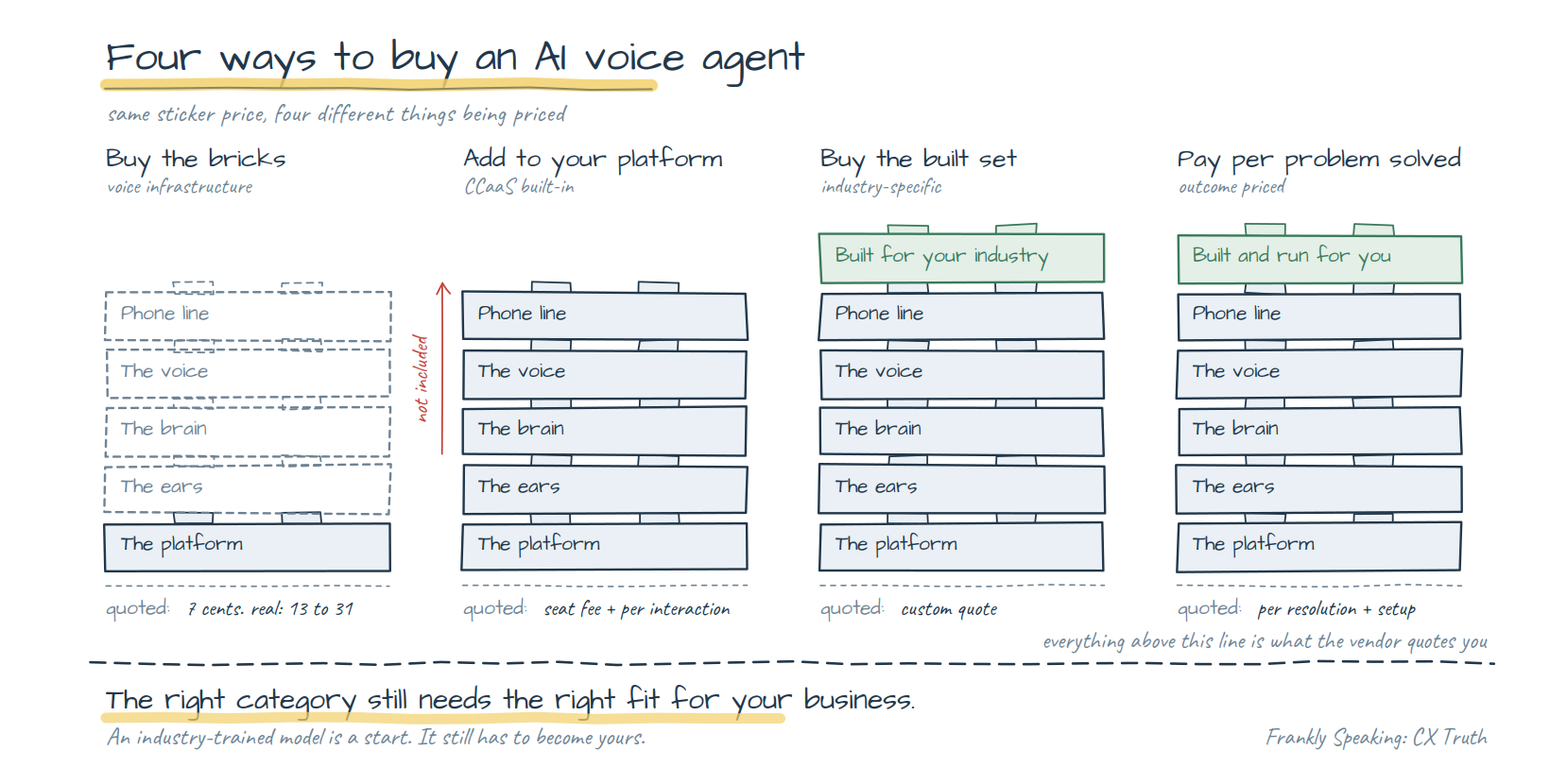
An AI voice agent needs five bricks to make a single phone call work:
- The ears. Software that turns what your customer says into text the system can read.
- The brain. The AI model that reads what the customer said and decides what to say back.
- The voice. Software that turns the answer back into speech. This is where the "does it sound like a robot" money goes.
- The phone line. The actual telecom carrying the call. Small, but it never goes away.
- The platform. The baseplate everything else snaps onto. It runs the conversation, tracks what was said, and connects to your systems.
Here is what those bricks cost, based on published 2026 rates. The ears run under a penny to about 2.5 cents a minute. The brain, under a penny to 8 cents. The voice, 2 to 10 cents. The phone line, about a penny. The platform, 5 to 14 cents.
Add them up and most real production deployments land between 12 and 25 cents a minute.
Now look again at the seven-cent quote.
Retell publishes seven cents a minute as its starting rate. That number covers the platform. It does not include the brain or the phone line, and Retell's own documentation puts most real setups between thirteen and thirty-one cents a minute once you add what you actually need.
The vendor is not lying to you. The vendor is quoting you one brick.
Four kinds of stores, and each one prices differently
Buy the bricks. Retell, Vapi, ElevenLabs. Cheapest per piece, most flexible, and you are the builder. ElevenLabs bundles agent minutes into its plans and charges around 8 cents per minute for overages, with the underlying LLM processing billed separately.
Add it to the platform you already own. Genesys, NICE. Genesys runs from $75 to $240 per user per month depending on tier, with telecom and implementation on top. NICE runs $71 for digital, $94 for voice, $110 for omnichannel, with its top AI suite at $249.
This category hides a detail that will change your whole business case. Genesys meters its AI capability separately, in tokens priced at $1 each. A basic voice bot runs 17 minutes per token, about 6 cents a minute. A standard virtual agent runs half a token per interaction, 50 cents a call, flat, no matter how long the call runs. Its most capable agent runs 1.2 tokens per interaction, $1.20 a call.
Here is the part that catches people off guard. If a call starts on the basic bot and escalates to the smarter agent, which is exactly what happens on your harder calls, Genesys bills the entire interaction at the highest tier it touched. A two-minute call that escalates gets billed like the top tier for the whole call, not just for the part that needed it.
Same vendor. Same platform. Two completely different cost curves, and the calls that need the most help cost the most to escalate, on top of everything else.
Buy the set built for your industry. Healthcare scheduling, legal intake, home services. Mostly custom quotes. You pay more, and you get a running start, not a finished product. An industry-trained model knows your vertical. It does not yet know your company, and closing that gap is still your job.
Pay only when the problem gets solved. Sierra charges when the agent actually resolves the interaction. Third party estimates put year one at $200,000 to $350,000, including $50,000 to $200,000 in setup. Intercom Fin charges ninety-nine cents per resolution.
Four models. Four different units of measure. You cannot line them up in a spreadsheet column and pick the smallest number, because they are not measuring the same thing.
The gap an industry-trained model does not close
I worked with a services firm in a specialized, niche vertical that picked the industry-specific route. On paper, it was the safe choice. The vendor had built this exact kind of agent before. The firm was not trying to reinvent voice AI. It just wanted the job done right for its space.
Deployment took about three months. Reasonable. The agent went live, and for the first two months nobody was worried.
Then the calls started drifting. Not badly, not obviously. Just in the way a voice agent drifts when nobody is checking its work. A little more generic. A little less aligned with how the firm actually handles its cases. A little further from what the front line would have said. Two months into production, someone finally pulled a sample of calls and found it.
Here is the part that matters. The platform was not broken. The industry training was not fake. What was missing was the thing that keeps any voice agent aligned with a real operation over time: ongoing QA and retraining, delivered by someone who understood how this firm specifically talks to its customers, not just how firms in this vertical talk to theirs.
The vendor did not have that capability to sell. Not a bad vendor. Just the wrong shape of vendor for what this firm actually needed.
That is the mismatch worth naming. It was not model versus model. It was mistaking an industry-trained starting point for a finished outcome.
Here is the principle underneath it. If your company is generic, you compete on price, and a generic industry model might genuinely be enough. But if you are not generic, and most companies reading this are not, your differentiation lives in the details a generic model was never built to capture. How your firm actually talks to its clients. The exceptions your process handles that the industry standard does not. The judgment calls your best people make without thinking about it.
An industry-trained model gets you a running start. Only ongoing human QA and retraining gets you an outcome that actually sounds like you.
The firm has since decided to move to a managed model with built-in QA and retraining. It is early. I will report back once there is real data to look at.
That mismatch is worth sitting with before you sign anything. It was not a bad platform. It was the wrong shape of vendor for what this firm actually needed, and nobody caught it until the calls had already drifted.
Next time, we will price what these four models never put in writing: the fees that show up after the contract is signed, and the math that tells you what a voice agent actually costs once you count everything it touches.
Which of these four models are you running today, or seriously considering? Tell me on LinkedIn. I read every comment.

New editions every two weeks. Subscribe on LinkedIn.