
Frankly Speaking: CX Truths
Your AI Voice Quote Has a Resort Fee. You Just Have Not Seen It Yet.
What is actually inside the bill after the contract is signed.
Umesh Jain · 15 September 2026

You have stayed at a hotel that quoted one nightly rate, then added a resort fee, a parking fee, and a service charge that only showed up at checkout.
Your AI voice vendor is running the same play on your contact center budget.
Two weeks ago, we broke down the four ways to buy an AI voice agent. This time, we are pricing what none of those four ever put in writing.
The costs quoted, and the costs discovered later
Most conversations about AI voice agents stop at the sticker price. Line one, in the contract, in bold: dollars per minute, or dollars per call. Everyone reads that line closely. Almost nobody reads the parts that were never written down at all.
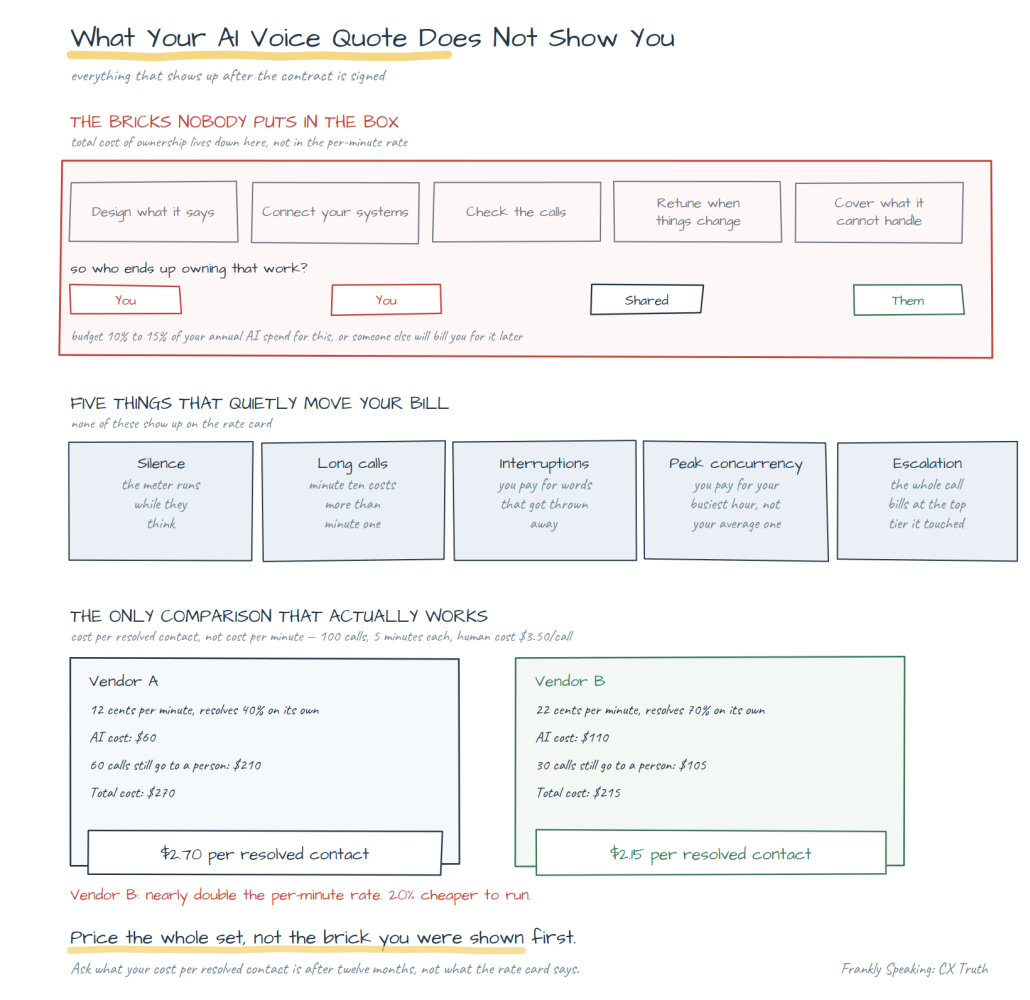
Somebody has to write the instruction booklet. What the agent says, in what order, and what it does when the customer goes off script. Which they always do.
Somebody has to connect it to your other systems. Your CRM, your scheduling system, your billing platform. In year one this is usually the single biggest line item, and it is almost always quoted separately, if it is quoted at all.
Somebody has to check the calls. You would never run a human team with zero quality review. Do not run an AI agent that way either.
Somebody has to rebuild it when things change. Voice agents drift. Your products change, your policies change, your promotions change. Budget for this or you will have a strong agent in month three and an embarrassing one by month nine.
Somebody has to handle what it cannot. The hard calls still land on a person. And here is the part almost every business case misses: once the AI takes the easy calls, your human agents are only handling the hard ones. Average handle time goes up. Cost per human call goes up with it. That is not a failure. That is math, and it needs to be in your model from day one.
In my experience, budget ongoing QA and retraining at somewhere between 10% and 15% of your annual AI spend. Vendors rarely put a number on this line. That is exactly why you need one.
Four things that quietly move your bill
You pay for silence. The listening engine keeps running while the customer pauses, thinks, or reads an account number off a bill. Retell says this plainly in its own FAQ. Most vendors do not.
Long calls cost more per minute than short ones. The AI re-reads the entire conversation every time it responds, so minute ten costs more than minute one.
You pay for interruptions. When a customer talks over the agent, the words the agent had already generated get thrown away. You still paid for them. Poor turn-taking can add 10% to 30% to your largest cost line.
You pay for your busiest hour, not your average one. Most platforms charge for concurrent calls. Vapi includes 10, then charges $10 per additional line per month. Synthflow includes 5 to 25 depending on the plan, charging $7 to $20 per additional line per month. Some charge double when you burst past your limit. And if you need a signed HIPAA agreement, that can be a flat $1,000 a month on top.
You pay the top rate for the whole call, not just the hard part. Genesys, for one, bills its AI tiers by the highest resource a call touches. If a call starts on the basic bot and escalates to a smarter agent when it gets complicated, the entire interaction gets billed at the smarter agent's rate, not just the escalated portion. A two-minute call that escalates in the final thirty seconds gets billed at the top-tier rate for the full duration. The calls that need the most help end up costing the most to escalate, on top of everything else.
The only comparison that actually works
Stop comparing cost per minute. Compare cost per problem solved.
Run one hundred calls, five minutes each, with a loaded human cost of $3.50 per call.
Vendor A quotes 12 cents a minute and handles 40% on its own. That is $60 in AI cost, plus 60 calls still going to a person at $3.50 each. Total, $270. Your real cost is $2.70 per contact.
Vendor B quotes 22 cents and handles 70%. That is $110, plus 30 human calls. Total, $215. Your real cost is $2.15 per contact.
Vendor B is nearly double the price per minute and 20% cheaper to run.
That is the whole argument. The rate per minute tells you what the tool costs. The cost per resolved contact tells you what the decision costs.
The services firm from two weeks ago never got to run this math. Two months into production, before anyone had a clean cost-per-resolved-contact number, the drift was already showing up in call quality. That is the real cost of picking a model without a plan for who keeps it accurate once it is live.
Price the whole set
There is a fifth option that does not show up in most comparisons, and it is worth naming.
You can buy the bricks yourself and build it, which gives you the lowest sticker price and the highest workload. You can buy the finished set, which gives you the highest sticker price and the least control. Or you can work with someone who buys the bricks at volume, builds the set for your operation, keeps a human team reviewing the calls, and stays around to rebuild it when your business changes.
That third path does not have a per-minute number you can put in a comparison chart. That is precisely the point. Its value shows up in the containment rate, the quality scores, and the calls that never had to be redone.
Do not ask a vendor what their per-minute rate is. They will tell you, and it will not help you.
Ask this instead: at my volume, with my call types, what is my cost per resolved contact after twelve months, and what are you assuming about the work I have to do myself?
The vendors who can answer that question are the ones worth talking to. The ones who cannot are quoting you a brick and letting you assume it is the set.
If you have a voice agent live today, ask whoever owns it what your real cost per resolved contact is, and who is checking the calls this month. If either answer is unclear, that is worth fixing before it shows up in your numbers. What did you find? Tell me on LinkedIn. I read every comment.

New editions every two weeks. Subscribe on LinkedIn.