
Frankly Speaking: CX Truths
Wall Street Says Call Centers Are Uninvestable. It Is Half Right.
The old model deserved the selloff. The work it did still matters.
Umesh Jain · 13 October 2026

In one morning in late June, the two largest call center companies in the world lost as much as a quarter of their market value. One of them had just cut its forecast and warned that clients were spending less. An analyst covering the sector pointed to the detail that worried him most: some clients had simply stopped offering customer support in certain areas.
This summer, investors reached a verdict. Answering the phone for other companies is a dying business.
Last month, the same company wrote off more than a billion dollars in goodwill, because its stock had fallen so far.
I run one of these companies, a much smaller one, so weigh what follows with that in mind. After twenty-five years in this industry, here is my view. Wall Street is half right.
Where Wall Street is right
A little over a year ago, I wrote that labor arbitrage had run its course. For decades, outsourcing worked because people in another country cost less than people at home. That was the whole pitch: same coverage, same handle time, lower rate.
AI breaks that pitch, and not in the way most people think.
The problem is not that AI is cheaper than an offshore agent. The problem is how the old model gets paid. Most outsourcing contracts still bill by the hour or by the agent, so every call AI absorbs is revenue the vendor loses.
The vendor is being asked to bring you the very tool that shrinks its own invoice.
The bigger the company, the more headcount it has to protect, and the harder that conversation gets. Investors can see the math. A business priced on hours cannot easily sell you fewer hours.
On that, they are right. That model deserved the selloff.
Where Wall Street is wrong
Investors are pricing a world where AI replaces the agent. The numbers do not show that yet. In the same quarter it wrote off more than a billion dollars, that company’s revenue fell by about one percent. The stock was priced for a collapse. The work kept coming in.
What I see in my own operations points the same way.
Here is a recent example. A dental group ran a phone program staffed only by humans. Calls came in sharp spikes, mostly about appointments, and the budget was fixed. During peak intervals, thirty to forty percent of callers hung up before anyone answered.
The honest fix was more people. The budget would not allow it.
So we started with the humans, not the bots. We used AI to analyze every call, why the customer called and how the call ended. That fed daily workforce planning, so the right people were in their seats when the spikes hit. Then we put AI next to the agents during calls, with live guidance and faster access to the triage process.
Peak abandonment fell below ten percent. In eight of ten intervals, it dropped below two percent. Headcount stayed the same.
Only then did we add a voice AI agent in front of every call. It answers simple questions on its own, about five to seven percent of volume, and it smooths the spikes so the humans see a steadier flow. Within three weeks, peak abandonment was down to six percent.
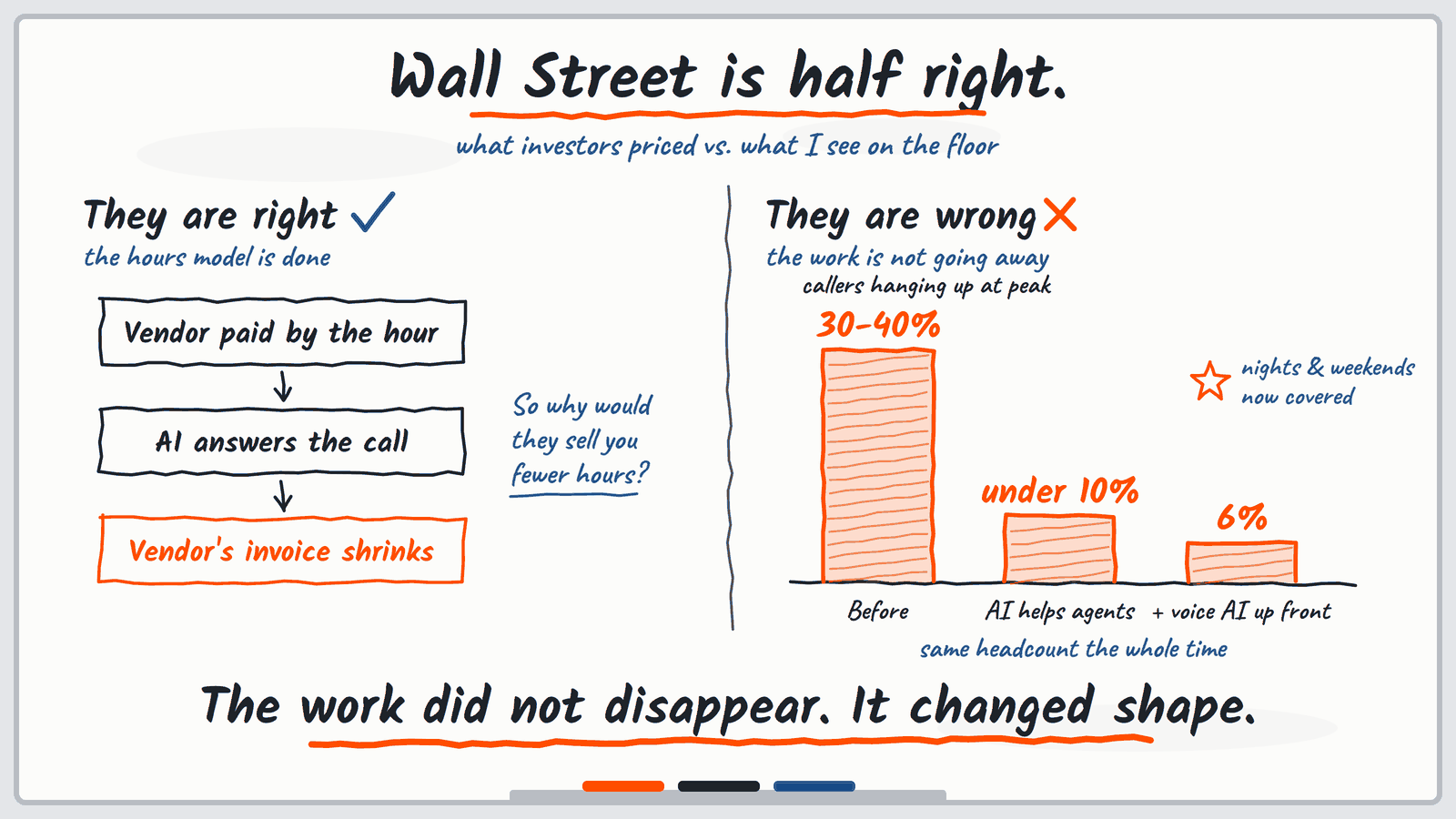
The voice AI also picked up something nobody had covered before: nights and weekends. That is only three to four percent of weekly volume, but those callers used to get nothing. Now they get an answer, and anything that needs a person is queued for follow up.
The early business signs are encouraging. Patient feedback is positive, and no shows and late arrivals are coming down. I want three months of trend before I call that a result, so treat it as a signal for now.
Look at what actually happened. The voice AI resolves only a small slice of calls on its own. Most of the improvement came from making the same people better at their jobs. Nobody lost a seat. The customers who used to hang up now get through, and the ones who called after hours now get help.
That is not AI replacing the work. That is AI doing what the budget could not pay people to do.
And someone still has to run it. Someone reads the call analysis and changes the schedule. Someone coaches the agents on the guidance. Someone checks what the voice agent says and fixes it when it drifts. The work did not disappear. It changed shape, and the new shape needs more skill, not less.
Three questions worth asking your vendor
If the old model is dying and the work is not, the real question is whether whoever runs your customer operations, in-house or outsourced, is built for the new shape. Three questions will tell you quickly.
Ask them to show you, not tell you. Every vendor now claims AI capability. Ask yours for one AI deployment it runs in production today. What broke in the first ninety days? How did they catch it? What did they change? A vendor who has done this for real will have a specific story, with a failure in it. A vendor who has not will give you a demo.
Ask who keeps the savings when AI takes volume. If AI handles more of your calls next year, does your price come down, or does your vendor find a reason for it to go up? If the answer is unclear, the contract was written for the old model.
Ask whether they are paid for hours or for outcomes. A vendor paid by the hour earns more when your calls run longer and your customers call back. A vendor paid for outcomes earns more when your customers get helped the first time. Only one of those is on your side.
The bottom line
Wall Street wrote off a model that charged for hours and sold headcount. It deserved it.
But the customers calling those companies did not go away. They still need someone to answer, someone to fix the problem, and someone to notice when the system gets it wrong. The vendors who survive will be the ones who get paid for that.
If your vendor’s revenue goes down every time your customers get faster service, whose side is the contract on? Tell me on LinkedIn. I read every comment.

New editions every two weeks. Subscribe on LinkedIn.