
Frankly Speaking: CX Truths
That Call Resolved on First Contact. It Still Cost Them a Customer
Your AI is being graded on the wrong number, and your customers are quietly routing around it.
Umesh Jain · 29 September 2026

I say "agent" three times at the start of any automated call now. The third time usually works.
That habit built up slowly, over a couple of years and a lot of bad systems, but my pharmacy is where it hardened into a rule.
The voice agent was the only way in, with no option for a person and no zeroing out. It asked my name, I spelled it, it got it wrong, so I spelled it again and it got it wrong again. Then it asked me something where my answer did not match whatever branch it was expecting, and it looped. I explained what I needed three different ways while it kept asking me something else, so eventually I gave up and started asking for a human, which took three tries.
The woman who picked up was excellent, and she also asked me for every piece of information I had just spent five minutes giving the machine, because the machine passed none of it along. Nine minutes on that call in total, four of them with her.
And it counts as a success in their reporting.
One contact, issue resolved, no callback. If somebody there is looking at a containment dashboard this week, my call is a green number on it.
That is the problem with leading on resolution: it tells you the thing got done, and nothing about what it cost me or whether you delivered it the way I wanted. I built a workaround to avoid that pharmacy, and I now use it on everyone, including the companies that did the work properly. They did not lose one call. They moved me.
There is a model for this, and it is older than the problem.
Dr. A. Parasuraman, who has been a mentor of mine for years, built the Technology Readiness Index with Charles Colby in 2000. It was written for online banking and self-service kiosks, back when the hard question was whether people would type a credit card number into a web page.
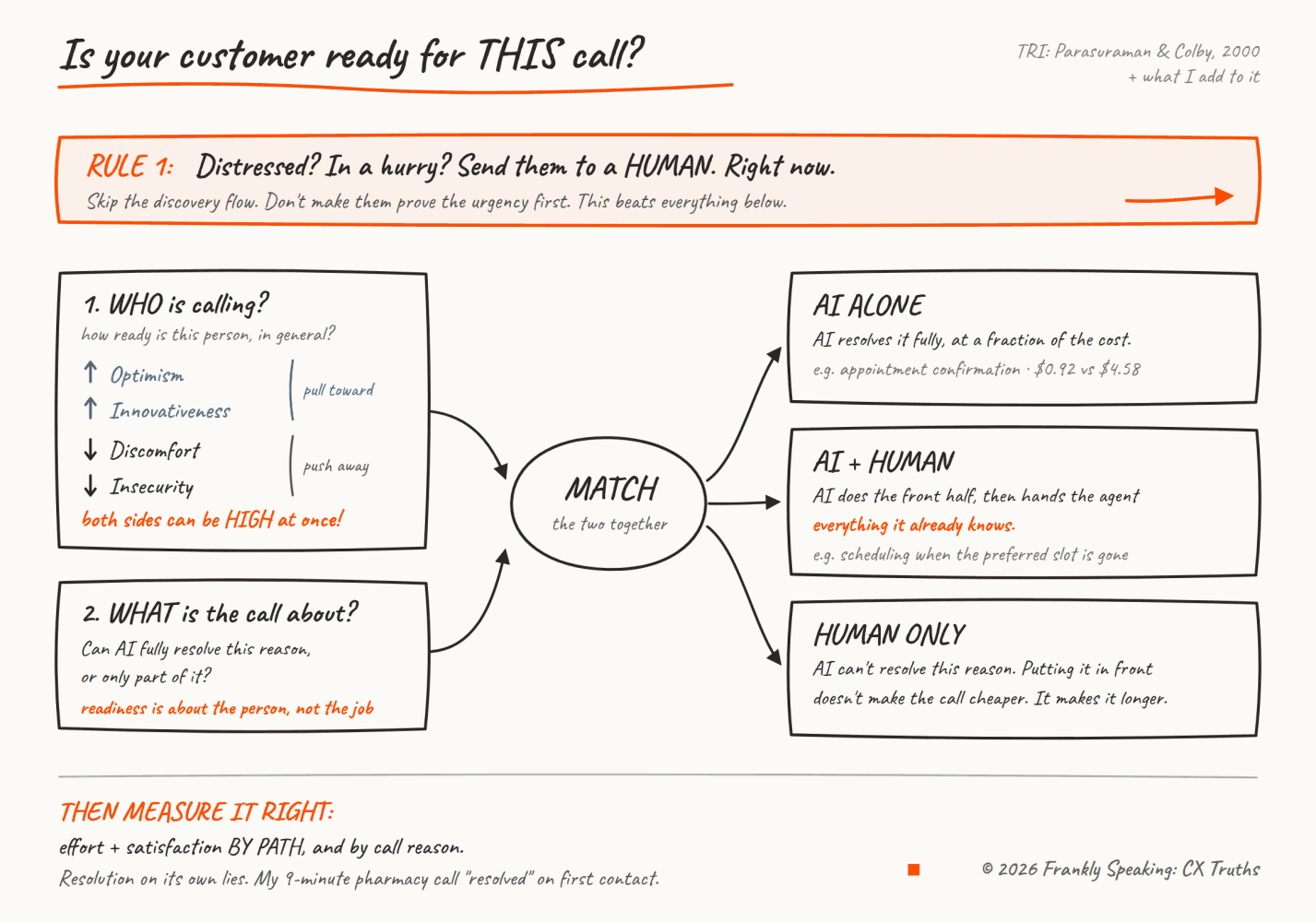
The question it answers has not aged at all: how ready is this person to hand a task over to a machine? Not their age or their skill level, but their disposition. It reads four things and deliberately keeps them apart.
Two of them pull a person toward technology:
- Optimism. They believe it gives them more control and more speed.
- Innovativeness. They tend to go first, before other people do.
Two push them away:
- Discomfort. They feel out of their depth, and that doubt turns inward.
- Insecurity. They do not trust it to work properly, and that doubt points outward at the machine.
Here is the part most people miss. These are not two ends of one scale, which means the same person can want your AI badly and distrust it badly at the same time. Wanting it doesn't cancel the fear, and fear doesn't mean they were never interested in the first place.
Score me, and I land where the model puts its Pioneers, because I want the technology and I will try it before you ask me to. That makes me the customer your business case was built around, and the pharmacy lost me anyway. I was ready for them. They were not ready for me.
Here is what I would add to the model.
It tells you about the person, but it tells you nothing about the job, and that gap is where routing decisions go wrong. Someone perfectly happy to let a bot confirm an appointment may want nothing to do with a bot on an insurance coverage question. Same person, same day, opposite answer.
So, I use three dimensions instead of one:
- Who is calling. How ready is this person to hand anything over to a machine.
- What they are calling about. Can AI fully resolve this reason, or only part of it.
- How it gets delivered. AI alone, AI with a human, or a human from the start.
And one rule that overrides all three: if the caller is distressed or in a hurry, get them to a person immediately. No discovery flow, and no making them prove the urgency first.
I watched that one get missed at a personal injury firm. Someone called right after an accident, shaken and in pain, and the voice platform did exactly what it was built to do. It started collecting accident details, then police report questions, then insurance questions, with no way to reach an intake agent. The caller hung up.
The firm found out four days later, when somebody in IT happened to be reviewing abandoned calls, and by then the case was with a competitor. The technology had worked as designed. The design never accounted for the state the caller was in.
What it looks like when all three line up.
A dental group I work with runs both sides of this well. Appointment confirmation goes to AI alone and beats the human channel outright, because callers get what they need without a queue and without waiting for office hours. Five stars.
Scheduling is where it gets more interesting. When the patient's preferred time is gone, the AI handles the first part and then hands the agent three things: who is calling, the options it already checked, and the time the patient actually wanted. The agent picks up mid-problem instead of at the beginning, and those calls also come back at five stars.
That is the same warm transfer as my pharmacy call with one variable changed, which is that the dental system passed along what it already knew.
The economics hold up too. On one of those call types, AI alone costs $0.92 per call against $4.58 for a human, with the same resolution either way, and when the outcome is identical at a fifth of the cost there is nothing left to debate.
Run it backwards and you find where the money is actually going. If AI cannot resolve a call reason, putting AI in front of it does not make the call cheaper, it makes it longer. The pharmacy paid for five minutes of AI and then paid for the whole human call that was always going to happen. Cost up, resolution unchanged, satisfaction down, and a customer trained to bypass them. That is not a trade-off, it is loss on both sides, filed as a containment attempt.
So measure the right things.
My pharmacy call resolved on the first contact. If that is your headline number, you just recorded nine wasted minutes as a win.
Notice what my two failures have in common. Mine was contained and looked good on the dashboard, while the accident call was abandoned and nobody looked at it for four days. Those are two different blind spots in the same reporting stack, and neither one surfaces while resolution sits on top.
What I watch instead is effort and satisfaction, both split by path. Not overall NPS or CSAT, but broken out by whether the interaction was AI alone, AI plus human, or human alone, and by call reason. Effort matters most on the calls that technically succeeded, because that is where the damage hides. First Call Resolution still belongs in the set, split the same way, since it tells you the ceiling on what AI can handle for each reason. It is just not the headline.
On one program over thirteen weeks, moving call reasons to the channel that fit them took NPS on those interactions from +18 to +30, and First Call Resolution from 68% to 72.6%. The twelve-point NPS gain is the number I would take to a board, and we did not improve the AI to get there. We stopped asking it to do things it was not good at.
People ask me for benchmarks constantly, and I don't use them, because the industry-average containment rate was measured on someone else's customers calling about someone else's problems. I use the client's own rolling three- to six-month baseline and watch week-over-week movement against it.
When someone asks how fast you can move to AI, the real question is not whether the technology is ready.
Your IT team will say it is, and they are probably right. Your CFO will point to the savings, which, in some cases, are real.
The question is whether your customers are ready, for what specifically, and which ones. That has been measurable since 2000, and most companies still deploy without asking.
So take your highest-volume call reason and tell me in the comments whether you know how your customers rate it when a machine handles it versus a person. CSAT or NPS, whichever you run. If you do not know, that is the answer, and it is the cheapest gap on this list to close. Tell me on LinkedIn.

New editions every two weeks. Subscribe on LinkedIn.