
Frankly Speaking: CX Truths
Marketing Counted Leads. Intake Counted Calls. Nobody Counted Cases.
Your team is measuring clicks and calls. Your business only gets paid for one thing.
Umesh Jain · 27 October 2026

Every Monday morning, two teams at a law firm sat down to argue about a number that did not matter.
The firm was a Personal Injury (PI) practice, and I was in the room as an outside advisor. I had been brought in to look at what was not working, follow the path from marketing spend to signed cases, and find where money was leaking along the way. That weekly meeting turned out to be the best place to start.
Marketing usually went first. They had charts showing clicks and website traffic climbing month over month, and they had every reason to be proud of them. Then intake would push back with their call logs. Volume was up, they said, but the callers were worse, with too many people who had no case or were not ready, and an intake team stretched thin chasing them. Each side had real data, each side was partly right, and every meeting ended the same way, with both teams sure the other was the problem.
What nobody said out loud was that the firm does not get paid for clicks, and it does not get paid for calls.
It gets paid for signed cases, and that was the one number neither team brought into the room.
If your marketing team hands off to a phone team, you have probably sat through a version of this meeting. In a dental group the argument is about booked patients and somewhere else it is about closed sales, but the shape of it is the same.
Three scoreboards, and nobody keeping the real score
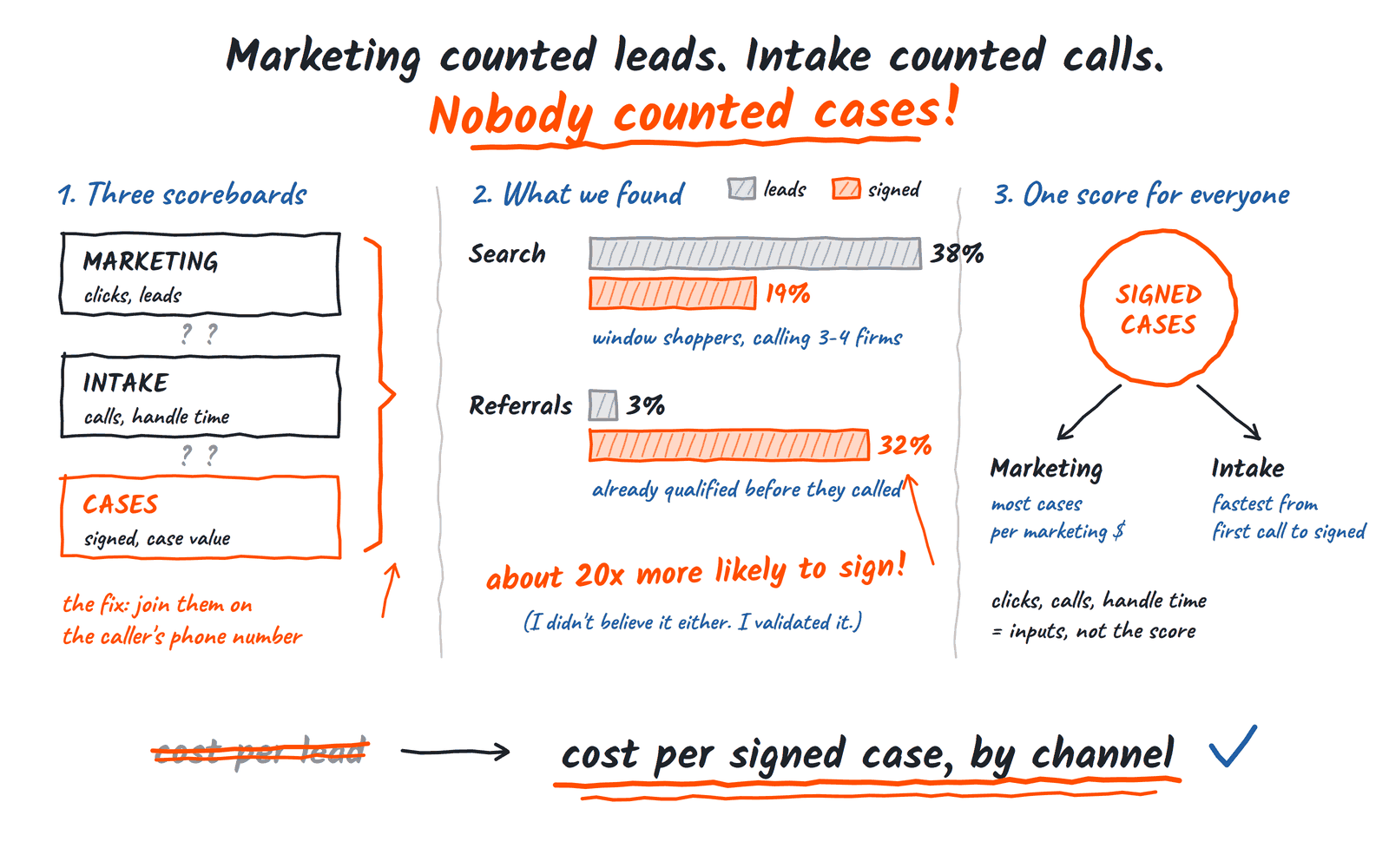
It did not take long to see why the argument never ended. The firm was running three separate scoreboards. Marketing had its ad platforms and web analytics, intake had the phone system, and signed cases lived in the case management system. Each one told a true story about its own piece of the business, and none of them could follow a single person from the first click to the signed retainer.
That blind spot sat exactly where the money was won or lost, in the conversation between the caller and the person answering the phone. Marketing’s view stopped when the phone rang, and the case management system only knew who signed. The call itself, which is where lead quality actually shows up, belonged to nobody. So the budget conversation ran on activity numbers, and money kept going to whatever produced the most calls.
Following the money to the end
The first change was to connect the scoreboards. We tied the phone, chat, case management and marketing data together so that every lead carried its source all the way to the outcome. The key that made it work was simple: the caller’s phone number. It shows up in the call tracking and in the case file, even when someone left the lead source field blank or typed something unreadable into it.
Following real leads from start to finish showed me how little the journey resembled the funnel most of us were taught, where a person moves neatly from awareness to interest to decision. People do not decide that way. A claimant might see a billboard, search the firm’s name a week later, ask a friend, read reviews, call two other firms and start a chat at eleven at night before signing anything. Every one of those touches shapes the decision, and a report that credits only one of them, usually the last, will keep sending the budget to the wrong place.
Then the numbers came in, and they changed the whole conversation.
Search, the channel marketing was proudest of, brought in thirty eight percent of the firm’s leads and produced nineteen percent of its signed cases. Referrals brought in three percent of the leads and produced thirty two percent of the signed cases. Put side by side, a referral lead was about twenty times more likely to become a client than a search lead.
When I first saw those numbers, I assumed something was wrong with the data, so I went back and validated them. They held up.
The reason made sense once we looked at who was calling. Referral leads arrived already qualified. Someone they trusted had sent them, they had a real case, and they had already decided they wanted help, so the buying signal was there before the phone rang. Many search leads were window shopping, calling three or four firms in an afternoon to compare. Some had a case and some did not, and some would sign that week while others were only gathering information. Every one of them counted as a lead on the marketing dashboard, and every one of them took up an intake specialist’s time.
So neither team had been wrong. Marketing really was driving more traffic, and intake really was handling more calls that went nowhere. They had been describing the same problem from opposite ends.
The number that pays the bills
This is where most marketing reports quietly mislead the people reading them. Cost per lead looks like a measure of efficiency, but all it tells you is what you paid to make the phone ring.
A channel can have the cheapest leads in your mix and the most expensive signed cases, and when that happens, every dollar you add makes results worse while the dashboard says things are improving.
To know what a lead is worth, you have to work backward from the outcome. For each channel, ask how many of its leads became signed cases and what you spent for each one. Compare the value of those signed cases with what the channel cost, and you have your return on marketing investment (ROMI) by channel. One honest adjustment keeps that number from flattering you. Some cases would have signed anyway, through a past client or the firm’s reputation, so a campaign only earned the signed cases that would not have come in without it.
Mohanbir Sawhney, who teaches a marketing program I am taking at Kellogg, puts it bluntly: “You cannot eat likes for lunch.” The people who sign the checks want the number with a dollar sign in front of it, and at this firm, that number was cost per signed case.
One score for both teams
The second change was harder than connecting the data, because it meant changing what each team was measured on. The answer itself was simple. Everyone would be measured on signed cases.
For marketing, the job became getting the most signed cases for every marketing dollar, by channel and by campaign. Clicks, traffic and lead counts still mattered, but as inputs to that goal.
For intake, the job became moving each lead from first contact to a signed case in the shortest possible time. Speed matters more than most firms realize, especially with the window shoppers, because whoever reaches them first usually gets the case, and a call returned the next morning is often a case that signed somewhere else overnight. Calls handled and handle time became inputs too.
Once both teams were looking at the same number, the Monday meeting changed. People stopped arguing about whose fault the month was and started asking where the next dollar should go, and which step between the first call and the signature was slowing things down.
Where you can start
You do not need a new system to begin. Where you start depends on what you already capture.
If you have call tracking and your case management system stores the caller’s phone number, join the two on that number and you will see how many contacted leads signed, broken out by source. With a few months of history you can look back right away. If you are starting fresh, give it sixty to ninety days, because cases have to sign before you can count them.
If you do not capture the lead source at first contact, start there, and make sure that source follows the lead all the way to a signed or declined outcome. The first report you can trust will take about a quarter, which feels slow, and it is still faster than another year of guessing.
Whichever step you are on, put signed cases and cost per signed case by channel in front of your team every week, next to cost per lead, and bring that report to the meeting where the budget gets decided, so the number actually changes where the money goes.
Do your marketing and operations teams report on the same number? If not, what would each of them pick? Tell me on LinkedIn. I read every comment.

New editions every two weeks. Subscribe on LinkedIn.