
Frankly Speaking: CX Truths
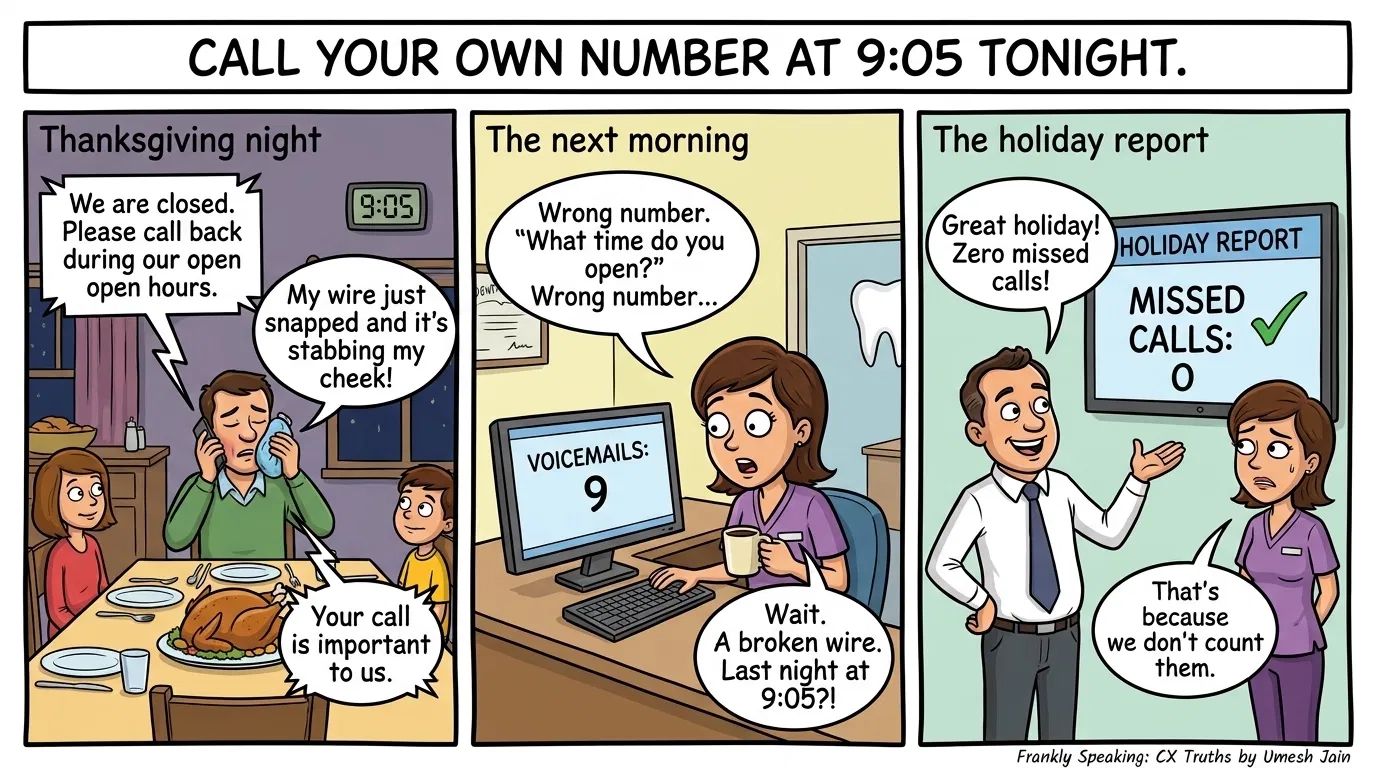
Call Your Own Number at 9:05 Tonight.
What your patients hear after hours is the part of your service nobody measures.
Umesh Jain · 24 November 2026

Fewer than five patients will call one dental group I work with on Thanksgiving Day. Every one of them will hear the same recording: we are closed, please call back during our open hours.
Call your own number at 9:05 tonight, five minutes after your office closes, and listen to what your patients hear.
At that group, you could leave a voicemail, and someone would get to it the next morning when staff had time. There was no way to ask for a callback at a particular time, and nobody tracked how many of those callers ended up booking somewhere else.
Too few calls to staff, too important to ignore
The volume after hours is small. A full weekend brings fifteen to twenty calls. Across a normal week, the hours when the center is closed account for less than three to four percent of calls.
Nobody is going to staff a person for five calls on a holiday, and I would not recommend it. But look at who is calling. Some are general questions that could be answered in thirty seconds. Some are wrong numbers. And every so often it is someone in real pain, with bleeding or a broken wire, who needs to know whether to go to the emergency room tonight or get the first appointment tomorrow.
A closed message treats all three the same way, and so does a voicemail box.
The person with a question waits until morning, the person in pain hears the same recording as the wrong number, and the practice never finds out what any of them needed.
That is why I think after hours is the best place to start with AI voice. The volume is low, so the risk is low, and the bar to beat is a recording that helps nobody.
More than an answering service
An AI voice agent can do more than take a message. It can answer the simple questions on the spot, using the practice’s own information. It can work out why the person is calling. It can recognize an emergency and, if the practice has someone on call, send the caller to the on-call phone. And for everything else, it can start the work for the morning team instead of leaving them a pile of voicemails to sort.
In the program we run, the callback queue captures the caller’s details, why they called, and the appointment details if the call is about an existing appointment.
The queue is sorted by need: emergency follow-ups first, then today’s appointments, then this week’s, then everything else. The first call the team makes is the one that matters most, not the one that came in first.
To be clear about who does what: the AI answers after hours, and people call back. If there is an emergency and someone is on call, the call goes to them. If the on-call person does not pick up, the agent leaves them a voicemail, sends them a text to follow up, and tells the caller what to expect next. That part still needs tuning, and we will improve it as more calls come in and show us where it falls short. Nobody is pretending a person is picking up at three in the morning.
What went wrong at first
Our first version was too generic, and that taught us more than anything else.
Questions about a specific location or a specific doctor got the same standard answer as everything else. Existing patients were slow to use it, and I understand why. If you call about your own appointment and get a brochure, you hang up and call back in the morning.
What fixed it was better information. Take office hours. A general answer says the office is open from eight to six. But some doctors cover more than one location, so the real question is whether the doctor you need will be at your location on the day you want. Once the agent could check each doctor’s schedule for the coming week at each site, it could give an answer a patient could actually use.
Emergencies followed the same path. At first, the agent looked for obvious words like pain, bleeding or a cut wire. Since then, we have trained it on the phrases patients actually use, practice by practice and specialty by specialty.
None of that worked until we built a simple process to keep the agent’s information current. When a doctor’s schedule changes or a site closes for a holiday, the agent needs to know the same day. Once that process was in place, adoption picked up. There is a bigger story here about using one trusted source of information for everything, people and AI alike, and I will come back to it in a future post, because it deserves one of its own.
Start simple, then let real callers show you what to add
The mistake I see most often is trying to build everything on day one.
Start by capturing why people call and routing them. That alone replaces the closed message with something useful, and it gives you data you have never had.
Then handle the simple questions. In our daytime program, the voice agent now resolves about eight percent of calls on its own, things like directions, open hours and general questions. It routes the rest to the right place, including calls that need to go straight to an office and never needed a call center agent.
Next comes confirming appointments. After that, simple scheduling and rescheduling, once the agent is connected to the practice’s systems and a central set of scheduling rules, with a person overseeing it.
Each step should be earned by what real callers ask, not by what a vendor demo can do.
Measure caller satisfaction, how much effort the caller had to make, and whether the outcome was correct, and use those to decide what to tune and what to add next.
What to do this week
The dental group I described at the start moves to this approach in December. The first thing we are adding is the tracking they never had: how many people call after hours, why, and what happened to them.
You can start before any technology decision. Call your number tonight after close, then call it again on Thursday, when you are closed for Thanksgiving. Listen as if you were a patient with a question, and then as if you were a patient in pain. If you get the same recording both times, you know where to start.
Call your own number after hours this week. Tell me on LinkedIn what you heard. I read every comment.

New editions every two weeks. Subscribe on LinkedIn.