
Frankly Speaking: CX Truths
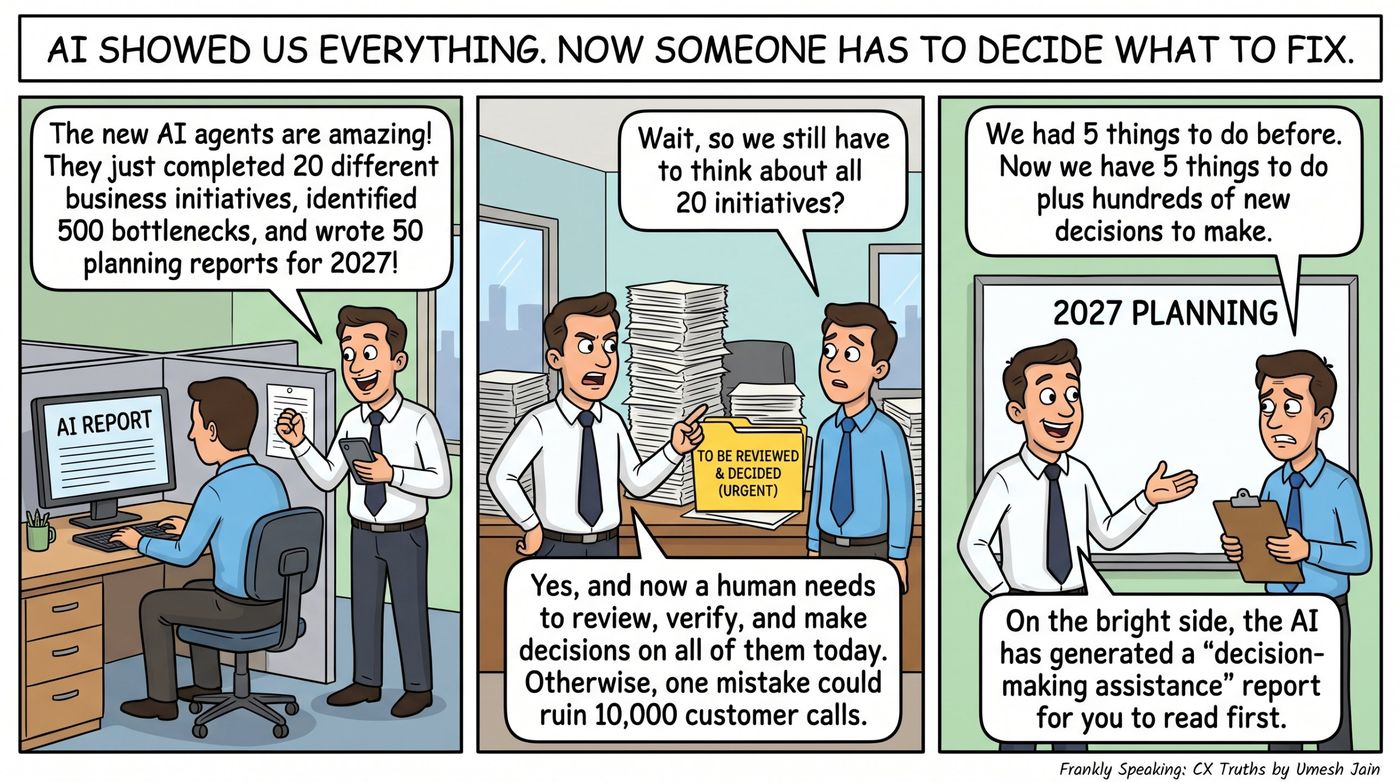
AI Showed Us Everything. Now Someone Has to Decide What to Fix.
Planning for 2027 starts with admitting where the bottleneck moved.
Umesh Jain · 10 November 2026

Before AI, I worked on four to six initiatives at a time. By this fall, I had eighteen to twenty running in parallel.
Nobody planned that. It happened the way most things happened with AI this year, one useful tool at a time.
What AI actually did to my year
The promise was that AI would take work off my plate and give me some evenings back. In a narrow sense, it delivered, because tasks that used to take me days now take hours.
Take bookkeeping. I set up AI agents to handle it and to review my financials in far more detail than I ever had time for. The bookkeeping got faster, and then something I did not expect happened. The agents started pointing out things I had never looked at: patterns in costs, small leaks, questions worth asking. Before, I didn't know what I didn't know. Now I do, and every one of those findings is waiting for me to decide what to do about it.
The same thing happened across the business. I can now see detailed performance and recommendations for every client and every program we run. Our marketing, content, and social media tracking improved more in one year than in the previous five. Each of those is a real gain, and each one also produced a new stream of findings that needs a person to read it, question it, and decide what happens next.
So instead of my evenings back, I got a longer list.
An old pattern with a new engine
An English economist, William Stanley Jevons, noticed this with coal in 1865. As steam engines got better at using coal, Britain did not burn less of it. It burned more, because coal power became cheap enough to use in places where it had never been worth the cost. AI did the same thing to analysis, drafting, and review. They got cheaper, so I am doing far more of all three, including work that sat on my wish list for years.
That part is good news. The problem is where the extra work ends up, because almost all of it lands in the same place: a decision only a person can make.
What this looks like on a contact center floor
The clearest example in our own operations is quality assurance (QA).
Before AI, our QA team spent most of its time listening to a small sample of calls and scoring them. Now AI reviews every interaction, and the visibility is remarkable. We see business process problems, system issues, the specific coaching each agent needs, and what customers are actually telling us, across every call instead of a handful.
The QA team’s job changed instead of shrinking. They spend far less time scoring and far more time reviewing findings and coaching. And before anyone acts on a finding, someone has to check it. Do we agree with what the AI flagged? Where did the information come from? Does the analysis hold up? As more people across the business use AI tools, more of these questions arrive, and every one of them needs that check before anything changes on the floor.
That is slower, more careful work than scoring calls ever was. It is also the work that decides whether all that visibility turns into anything.
I have seen this before.
When I started my company, the idea was to help businesses understand their contact center data the way a Six Sigma Black Belt would, finding the real causes behind the numbers and tracking performance against them.
The analysis worked. What most organizations struggled with was the next step. They had the insight on a dashboard and no clear way to turn it into a change on the production floor, because the skills and time needed to act on it were in short supply. We ended up working side by side with many clients just to carry findings from the dashboard to the floor.
AI is bringing the same problem back, only faster and with far more data behind it. The tools can find and recommend at a pace no team can match.
Human judgment, the part where someone understands a finding, questions it, weighs it against everything else, and decides, still moves at human speed.
Skipping that step changes the size of the risk. One person making a bad call affects one customer. An AI change pushed out without review can repeat the same mistake across thousands of interactions before anyone notices.
How I cut twenty initiatives back to a handful
At some point this fall I realized I was spreading my attention so thin that none of the eighteen was getting real thought.
So I went back to a whiteboard. I wrote down the one overall goal I am trying to reach, and then I went through every initiative and asked whether it moved me toward that goal. The ones that clearly did became my focus list, and I cut it back to four to six. Everything else went into a pending queue, to be picked up when something on the main list is finished.
Nothing on the pending list is a bad idea. Most of them were things I had wanted to do for years. They just did not earn my best thinking right now, and the initiatives that stayed needed more of that thinking, including the time it takes to check AI output before I trust it.
Three questions for your 2027 plan
If your organization had a year like mine, here is where I would start.
First, what did AI make cheap that you are now doing more of? List it honestly, including the new reports, reviews, and insights nobody had before. Some of it is valuable, and some of it is just activity.
Second, who is acting on what it finds? For every AI capability you funded this year, name the person or team responsible for reviewing its findings and turning them into changes.
If nobody owns that, you are paying for insight that will sit on a dashboard, exactly as it did twenty years ago.
Third, what will you deliberately not do? Start from the problems you most need solved, rank them by what they mean to your customers and your business, and pick a short list. Then put basic guardrails around the AI you keep: one trusted source of information that both your people and your AI draw from, clear rules for what the AI can change on its own, and a named person who approves anything bigger.
The question I am taking into 2027
A friend asked me recently what I would attempt if I knew I could not fail. It is a good question, but it does not quite fit what AI changed.
AI removed most of the cost of trying, and left the risk of failure right where it was.
So here is the version I am using for planning: what would you attempt if it cost a tenth of what it used to? You will come up with a long list. The hard part, and the human part, is choosing the few that deserve your judgment.
How many initiatives are you running right now, and how many would survive if you could keep only five? Tell me on LinkedIn. I read every comment.

New editions every two weeks. Subscribe on LinkedIn.